
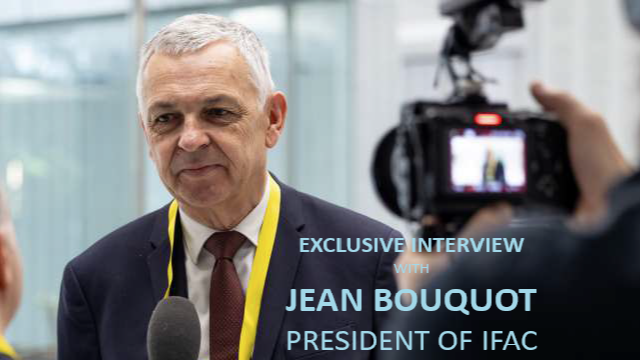
Interview with Jean Bouquot, President of the International Federation of Accountants (IFAC)
"The Certified Accountant is the most trusted player in the tax ecosystem"
On the sidelines of the UCALP congress held in Lisbon, the President of the world’s most important accountancy organisation provided an overview of the role of the profession in a context of geopolitical crisis and polarisation.
Interview by Nuno Dias da Silva | Photos by Raquel Wise
Contabilista – You assumed leadership of IFAC in November 2024. The presidency of the world’s largest accountancy organisation moved from Morocco to France, i.e., from the African to the European continent. Does this represent a new strategy or will there be continuity in the major objectives?
Jean Bouquot – The presidency of IFAC is a two-year mandate and the transition is always defined by continuity. I served as IFAC Vice-President for two years during Asmaa Resmouki's term, and our current Vice-President, Taryn Rulton, will work with me for two years. This shows how well planned the leadership succession is. Moreover, as Chair of the Board, I work on behalf of the entire profession, as do all the other Board members, regardless of their country of origin.
Contabilista – IFAC is the global voice of millions of Certified Accountants worldwide. Do you feel the weight of responsibility in being the face of an entity representing 180 professional accountancy organisations from 135 countries?
Jean Bouquot – I feel the weight of responsibility to the profession. Being President of IFAC is an incredible honour but requires total commitment in return. Let me add that although I represent IFAC personally with full dedication, I have the pleasure of working with 22 colleagues on the Board who embody the profession’s diversity and global nature in a way no individual could.
Contabilista – "Global", "influential", and "trusted" are the three key words of IFAC’s mission. Do you believe there is global recognition of the profession’s public interest role?
Jean Bouquot – Absolutely. Let me give one example. A recent IFAC report, in partnership with ACCA and the OECD, concluded that 68% of respondents trust information provided by Certified Accountants and tax advisers. This makes us the most trusted players in the tax ecosystem — more so than other important actors, including political leaders. We have earned the public’s trust, and that amplifies our influence in discussions on public financial management. But we must always continue to deserve that trust.
Contabilista – The Portuguese Institute of Certified Accountants (OCC) has been an associate member of IFAC since 2012 and a full member since 2016. What contributions and exchange of ideas do you expect with the Portuguese institution led by Bastonária Paula Franco?
Jean Bouquot – OCC has already achieved great things as part of the IFAC "family". It is actively engaged with various entities in Portugal, including government authorities and regulators. It is working with other accountancy organisations in Europe and beyond to support their goal of joining IFAC, including one of our newest members, the Consejo General de Economistas de España. OCC also plays an active role in three regional organisations: CILEA, the Mediterranean Federation of Accountants (FCM), and the UCALP. As host of two IPSASB meetings, OCC is gaining a reputation as a strong supporter of international standard-setting. All this signals great things to come in the relationship between IFAC and OCC, and I look forward to working closely with Bastonária Paula Franco during my mandate.
Contabilista – UCALP represents accountants from seven Portuguese-speaking countries and territories, totalling over half a million professionals. In what ways can this organisation be an asset within IFAC?
Jean Bouquot – One of UCALP's strengths is its diversity. The geographic, demographic, and economic variety within the Lusophone world enriches member discussions in ways that benefit all participants. Part of UCALP's value to the IFAC "family" lies in the opportunity to engage with the vibrant professional intersection showcased in UCALP's impactful, well-organised, and well-attended events. IFAC, and the profession as a whole, are stronger when our members are more closely connected and united in purpose and action — and this is one of the key outcomes of UCALP's collaborative work.
Contabilista – Before the G20 summit in Rio de Janeiro in November, IFAC called on major economies to prioritise sustainability, transparency, and governance to achieve the UN's Sustainable Development Goals by 2030. Do you believe enough is being done to promote a comprehensive sustainability reporting and assurance ecosystem?
Jean Bouquot – Within the profession, we understand the importance of the 2030 Agenda and the need for high-quality sustainability-related information. We see this as a core part of the profession's public interest mandate. As such, we are strongly committed to moving forward. This includes ongoing advocacy for the adoption and implementation of IFRS S1 and S2, and close involvement with sustainability standards recently finalised by the IESBA and IAASB. We want to ensure that all who use the standards can implement them effectively, and this requires collaboration across the entire reporting and assurance ecosystem. We also believe that regulators should hold unqualified accountants to the same standards and supervision as qualified professionals when applying the standards. That said, there are still many loose ends and some global resistance to the ESG pillars. However, the importance of high-quality information and its role in value creation and long-term thinking remain. We will therefore continue to advocate for high-quality sustainability reporting and assurance in our engagement with the G20 and do all we can to ensure the profession rises to the challenge.
Contabilista – How are organisations, depending on their size, managing the complexity of global sustainability reporting, which is becoming increasingly widespread?
Jean Bouquot – We are seeing a promising trend of professional organisations supporting their members through continuous development in sustainability-related services, including the OCC. These organisations are the first and most important source of support for members aiming to gain or update the qualifications required by the sustainability transformation. IFAC, in turn, works to support these professional organisations. We have also produced a wide range of reference materials and thought leadership on many aspects of sustainability, all available on our website.
Contabilista – The current times are far from peaceful: trade wars, a polarised world, and multiple global conflicts. Do you fear this instability and constant risk may spill over into the profession? Do global problems require local solutions?
Jean Bouquot – Geopolitical crises erode the diplomatic and commercial ties that hold the global economy together. This situation affects the profession, as we are consultants or part of companies across all countries and sectors. However, IFAC is an apolitical body, and the global profession can be a unifying and positive force in uncertain times. Global problems may require local solutions, but we can work towards greater global consistency and connectivity thanks to our ability to navigate technical and cross-cultural issues. We can lead our organisations toward greater resilience and better outcomes through trusted strategic advice. Fighting fraud, corruption, money laundering, tax evasion, greenwashing, and other illegal practices, as well as improving governance in both the public and private sectors, are key ways through which the profession can help enhance stability.
Contabilista – The unstoppable progress of artificial intelligence (AI) is affecting nearly all areas of society. Do you see this new era as a threat or an opportunity for the profession and its professionals?
Jean Bouquot – I do not wish to downplay the anxiety surrounding AI in our profession, but I am optimistic about its role for Certified Accountants and finance professionals. Its main impact will be to free us up to focus on higher-value areas such as advisory services, by automating lower-value tasks. This will enhance our relevance to clients and organisations. All of this depends on our ability to effectively adopt the technology. We must improve our digital skills to keep up with rapid changes in AI tools. Digital literacy is crucial, but we don’t all need to become data scientists! We should collaborate with other functions, such as IT, to complement our own expertise. And we must always consider our professional responsibilities in addressing emerging AI challenges, including cybersecurity, lack of transparency, and bias in AI models.
Contabilista – "Young Leaders Collective" is the name of IFAC’s latest advisory group, including representatives from several countries, among them Portugal. Is the profession attractive enough to draw in new generations entering the job market?
Jean Bouquot – The talented professionals in the Young Leaders Collective have shared their belief that the profession is well-positioned to attract future generations. They are eager to contribute ideas to IFAC on how to enhance the profession’s appeal, among other key topics on the profession’s agenda. The Collective is also developing recommendations for a global group of students and early-career professionals, beginning with a call to action in the coming weeks focused on sustainability. We are one of the most trusted professions in the world, and our role is extremely dynamic. We lead businesses, create sustainable value, advise large and small clients across sectors, provide assurance, and manage vast public and private sector budgets and programmes. But we must reclaim our narrative and tell that story!
Contabilista – At a time when there is much talk about the need to cultivate and foster ethical and socially responsible standards, do you believe the future is promising for the profession in this regard?
Jean Bouquot – One thing will remain constant: the indispensable role of our principle-based International Code of Ethics. The high standards of our profession and our unwavering commitment to integrity will remain unchanged. It is up to each individual to approach new challenges with an inquisitive mind. For example, we must recognise the potential of new technologies while remaining alert to unintended consequences. We must remain open to new research and developments that accompany the sustainability transformation. But this is not new. I have no doubt that we will rise to the occasion. We must also remember that working in the public interest is the profession’s permanent mission. That is what sets us apart from other service providers and is essential to the trust we bring to our clients and stakeholders. But this is not guaranteed; it requires ongoing attention. In this respect, IFAC’s role as the voice of the profession is crucial.
📌 The original Portuguese-language version was published in issue no. 299 (March 2025) of the OCC’s official monthly magazine “Contabilista”, available on the OCC’s website: 🔗 https://www.occ.pt/pt-pt/publicacoes

